

An inspection tells you how a structure looks on the day someone examines it. It cannot tell you whether a problem is getting worse or whether a repair is holding. Those answers appear only when the same property is documented again and compared with what came before.
That is the idea behind structural health monitoring. This guide explains what it is, how sensor-based and visit-based approaches differ, what a good program includes, and where it stops. It is written for owners, asset managers, and operators of multifamily and commercial properties across the United States.
What Is Structural Health Monitoring?
Structural Health Monitoring in Plain Terms
Structural health describes how well a structure is carrying its loads and resisting wear. Structural health monitoring is the practice of tracking that condition over time through continuous or periodic measurements and comparing each result with earlier ones. Engineers use it on bridges, dams, and buildings. The goal is simple: notice change early.
From a Single Snapshot to a Condition History
Most owners learn about a building’s condition in separate moments, such as a purchase, a refinance, an insurance renewal, or a repair. Each report answers one question and then goes into a folder. Monitoring replaces that pattern with an ongoing record. One observation is a data point. Several observations of the same area, captured the same way, show direction: stable, improving, or getting worse.
Structural Health Monitoring Systems: Continuous Sensors vs. Periodic Visits
The term covers two approaches, and the choice between them affects cost, coverage, and the kind of data you get.
Continuous Monitoring With Installed Sensors
A sensor-based structural health monitoring system works as a chain, starting with instruments fixed to the structure:
- Sensors measure how the structure responds
- A data acquisition unit collects the readings
- A transmission link sends them to storage
- Software analyzes the data and flags unusual change
Common instruments each answer a different question:
- Crack meters show whether a crack is opening or closing
- Tiltmeters show whether a wall or column is leaning further over time
- Strain gauges measure how much a structural element stretches or compresses under load
- Accelerometers record vibration patterns, which can shift when a structure’s stiffness changes
This approach produces constant data. Its drawbacks are installation effort, ongoing upkeep of the equipment, and a large volume of data that someone must interpret.
Periodic Monitoring With Scheduled Visits
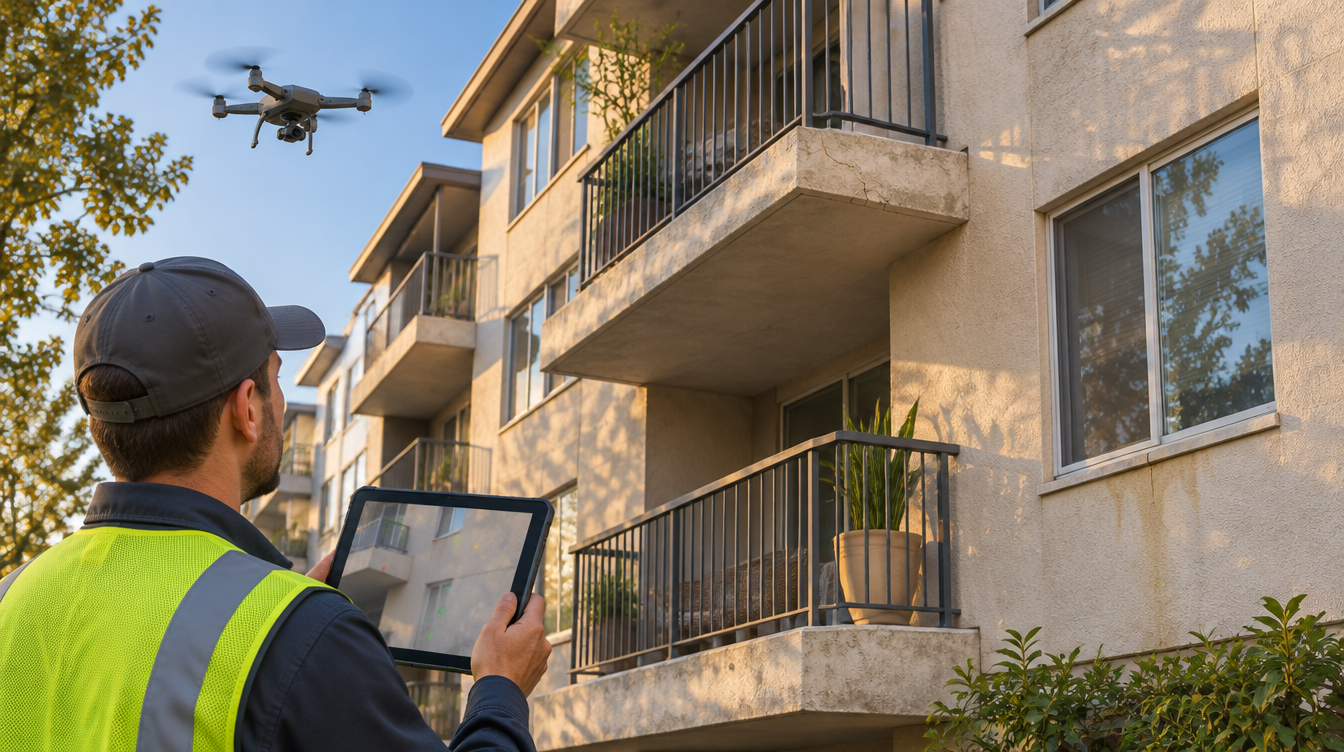
Periodic monitoring returns to the site on a set schedule. Each visit documents conditions with imagery and mapped observations. It needs no installed hardware and covers the whole property rather than a few instrumented points.
Which Approach Fits Which Building
Sensors fit a structure with a known concern that needs constant readings, such as a bridge, a dam, or a tall building where even small movement is worth catching right away. Scheduled visits fit many multifamily and commercial properties, where the goal is to follow how the property is aging, spot new cracking or water damage, and keep a record that others can review. The two can also work together.
Why One Inspection Is Not Enough
Problems Develop Between Inspections
Building problems rarely arrive suddenly. They grow quietly between visits. If a property is examined only when something forces the issue, the owner usually learns of a problem late.
Without a Baseline, Change Is Hard to Prove
Imagine a hairline crack found during a routine walk-through. Is it new? Was it there at purchase? Has it grown? Without an earlier record of the same spot, nobody can answer with confidence, and the discussion turns into opinion. A dated baseline removes that problem, because every later observation can be compared directly.
Building Structural Health Monitoring: What a Program Includes
A useful program is not complicated, but it needs a few essential parts.
A Baseline and Scheduled Return Visits
The first round is a baseline assessment. It records what is there today in detail, so each finding is tied to a location. Engineers review the results, so owners receive organized findings rather than a pile of photos. When as built documentation already exists for the property, it helps place those findings accurately. After that, the site is revisited on an agreed schedule. The interval depends on the building’s age, its exposure, and what the baseline revealed. What matters is that the schedule is set in advance and followed.
Comparison Against Prior Conditions and Repair Records
Each return is measured against the earlier record to identify what changed, what stayed the same, and what deserves attention. A finding that looked minor may need a closer look if it has grown. One that looked worrying may prove stable. When repairs are made, they go into the record too, so later rounds show how each repair is performing.
What Monitoring Can Catch Early
Movement, Cracking, and Water Intrusion
- New or widening cracks in walls, slabs, and masonry
- Signs of movement, such as gaps opening at joints or edges
- Staining, efflorescence, and other moisture marks
- Early deterioration of coatings, sealants, and exposed materials
How Acting Early Changes the Cost of Repair
Early findings usually allow modest responses: sealing, local repair, or closer observation. Late findings tend to need larger work, wider access, and more disruption for residents and tenants. Monitoring does not remove repair costs, but it gives owners time to plan and phase work instead of reacting to surprises.
Benefits and Limits of Structural Health Monitoring
Benefits for Owners, Lenders, Insurers, and Buyers
- Owners and asset managers get earlier warning and better information
- Lenders and insurers can see how a property has performed over time
- Future buyers get evidence in place of assumptions
What Monitoring Does Not Replace
Monitoring documents conditions and supports engineering review. It does not replace regulated inspections or design services, which must be performed by appropriately licensed professionals. When a finding calls for that level of review, the next step is a structural engineer inspection. Routine commercial building inspection still matters too, since monitoring tracks change rather than checking every system. A responsible provider says this up front.
Quick Answers
What is structural health monitoring?
It is the ongoing tracking of a structure’s condition through repeated measurements or observations.
What are some examples of structural health monitoring?
Examples include strain gauges and accelerometers on a bridge, crack meters on a wall, and scheduled visits that document the same areas each time.
What is the difference between structural health monitoring and a structural health assessment?
An assessment evaluates condition at one point in time. Monitoring repeats the evaluation over time to show change.
Does monitoring require sensors installed on the building?
No. Some programs use installed instruments, while others rely on scheduled visits.
How often should a property be monitored?
There is no fixed interval. It depends on what the first round finds.
Is monitoring the same as a structural inspection?
No. Monitoring tracks change over time. An inspection is an engineer’s professional evaluation.
Know How Your Building Is Changing
Datum Vertex Technologies helps owners across the United States build a condition history for their properties, combining drone and ground capture with engineering review, repeated at regular intervals. Based in South Florida, the team supports multifamily and commercial portfolios nationwide. If you want a clear view of your building over time, contact our expert team today to set up ongoing monitoring.
